

A Foundation Is Not an Afterthought
Every solar farm has an invisible foundation and a visible support structure – together, they determine the performance of the solar farm. FIRST BASE Solar Systems supplies complete ground-mounted systems: support structures combined with high-quality screw foundations.
According to Camile Gisbers, Sales Director at FIRST BASE Solar Systems, the foundation in solar projects is still too often seen as only a necessary investment. “In solar projects, the focus is usually on the above-ground components—panels, inverters, and cabling. However, the substructure literally carries the entire system and requires time and preliminary research. If the foundation isn’t adapted to the local soil conditions or lacks sufficient load-bearing capacity, unwanted settlement occurs in the supporting structure. This leads to structural stresses, misalignment, and foundation repair costs. That’s why we invest in thorough preliminary research and geotechnical analyses from the outset.”
Preliminary research determines the design
At FIRST BASE, every project begins with a thorough analysis of the soil conditions. By performing on-site pile load tests according to the Eurocode 7 protocol (EN 1997), the maximum achievable load-bearing capacity of our screw foundations is determined. During these load tests, both the load and the resulting pile head displacement are accurately measured and digitally recorded using our proprietary PLC measuring system. The results provide an accurate load-settlement diagram of our screw foundations, which our engineers then use to optimize the design of the supporting structure. This data forms the basis for a structurally safe design. “We believe it’s important to be able to offer a customized support structure, tailored to the client’s needs and the location-specific soil properties.”
Strong where the ground is not
Our screw foundations can be easily installed in locations with complex and/or weaker soil conditions, such as in clay and peat layers, or on dikes and/or embankments that are difficult to access. With compact screw-in machines, screw foundations are installed quickly and easily. Thanks to our wide range of lengths, diameters, and screw-in tools, a suitable configuration is possible for every location.
From design to implementation
FIRST BASE manages the entire process – from engineering and project preparation to installation and quality control – in close collaboration with established installation partners. “We supply screw foundations and supporting structure components directly from our own inventory, so the implementation isn’t disrupted by delivery times,” says Camile. “Where necessary, we scale up with multiple certified installation partners. With an installation capacity of up to 500 screw foundations per team per day, lead times remain short and schedules predictable.”
Practical example: A16 Rotterdam
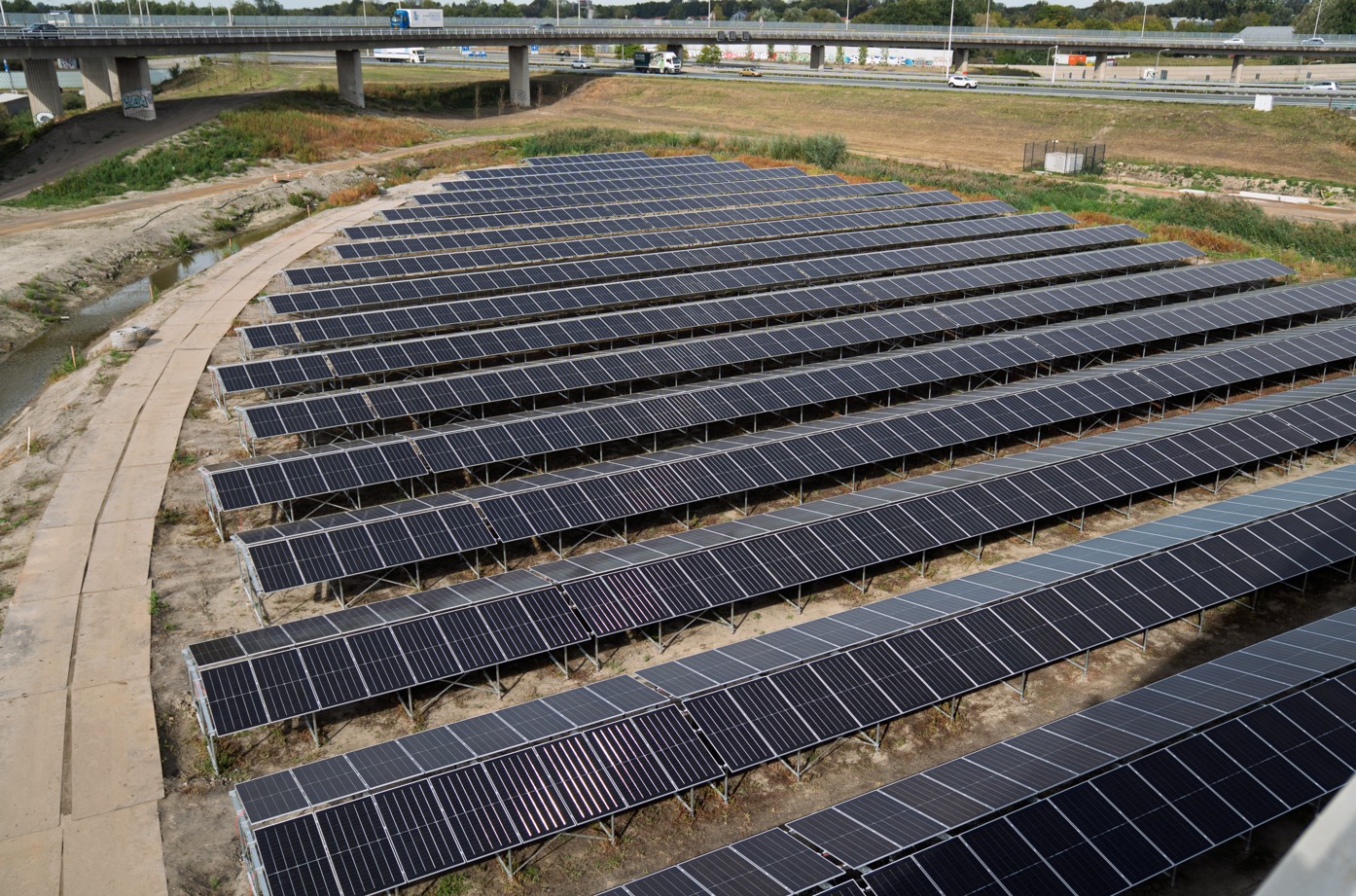
Along the new A16 motorway in Rotterdam, the solar farms were integrated into the cloverleaf interchanges at the on- and off-ramps. FIRST BASE supplied foundations and supporting structures for over 5,200 panels at six locations. During the preliminary investigation, various diameters of screw foundations were tested to achieve the required load-bearing capacity within the complex soil structure consisting of clay and peat layers. The energy generated by the solar panels feeds the installations of the Rottemerentunnel and is partly stored in two large battery systems (BESS), making the motorway energy neutral.
A foundation that performs as calculated
By coordinating technology, implementation, and logistics from the outset, FIRST BASE Solar Systems delivers a complete solution that performs as designed, both in calculations and in practice. The result: predictable performance and a reliable foundation for every solar farm.
Would you like to know more? Get in touch with us using the button below.